
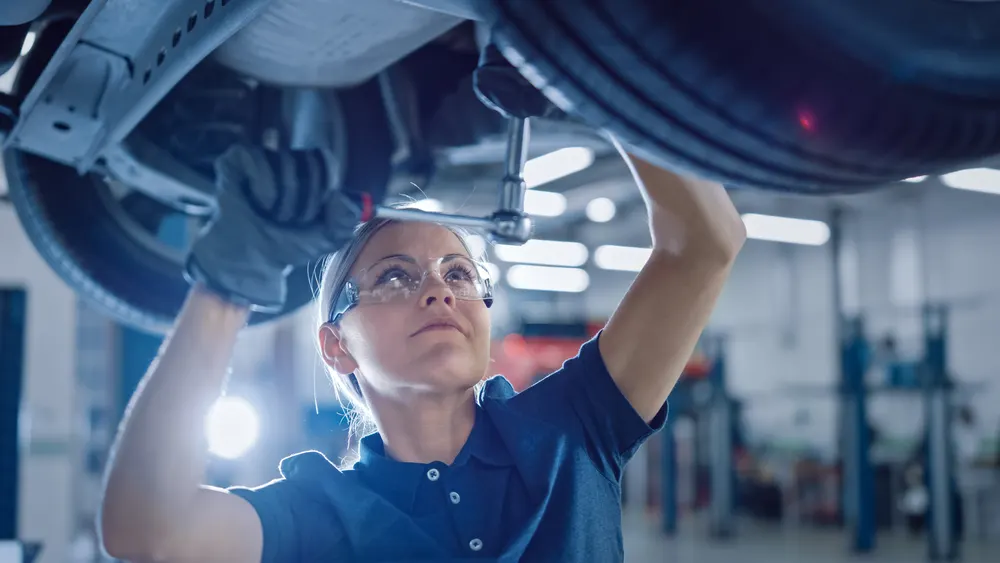
Car mechanics are professionals who are responsible for maintaining and repairing vehicles and diagnosing problems with them. They usually work in garages and workshops and can handle a wide range of vehicles, from cars to lorries to buses. Car mechanics have extensive knowledge of how vehicles work and how to identify and solve problems. He or she will use advanced diagnostic equipment and tools to fix problems with the vehicle and improve its performance.
In addition, car mechanics often have to communicate with customers to identify problems and discuss which repairs or maintenance are needed. Technology in the car industry is constantly changing, so car mechanics need to be flexible and proactive.
What do you do as a car mechanic?
The work can vary depending on the specific working environment, but in general the following tasks are typical for this role:
- Maintaining vehicles: this can range from simple maintenance work such as replacing oil, filters, tyres and brakes to more complex work such as replacing engines, gearboxes or steering systems.
- Repairing vehicles: you often repair problems with vehicles, such as engine problems, electrical problems, suspension problems or problems with the cooling system.
- Diagnosing problems: advanced diagnostic equipment is often used to detect problems in vehicles, for example reading fault codes, testing electrical systems or carrying out a thorough inspection of the car.
- Using tools and machines: they often use a wide range of tools and machines, such as lifts, tool cases, tyre changers, wheel balancers and computerised diagnostic equipment.
- Consulting with customers: you often have to communicate with customers to identify problems, to discuss which repairs or maintenance work are needed and to discuss the cost of the repair.
- Workshop maintenance: in this role you are responsible for maintaining the shop where they work. This includes cleaning the shop, tidying away tools and ordering tools and parts.
In which environments do you work as a car mechanic?
There are various environments in which a car mechanic can work.
- Garage and workshop: this is where most car mechanics work. Here you can repair, maintain and diagnose your car.
- Commercial vehicles: some car mechanics specialise in commercial vehicles such as lorries, buses and bulldozers.
- Dealerships: car mechanics work for dealers who sell and service specific brands.
- Government workshop: some car mechanics work for the government and maintain government vehicles such as police cars, fire engines and ambulances.
- Plant: car mechanics work for manufacturers, usually in factories or R&D departments.
- On location: some work in the field. They help companies and car parks solve vehicle problems.
What competencies does a car mechanic have?
Car mechanics need a number of specific skills to do their job well, including:
- Technical insight: in this role you need to understand well how vehicles work mechanically and electrically. Do you have technical insight but don't want to work as a car mechanic? Then also take a look at our other jobs in engineering and technology.
- Problem-solving skills: you need to be able to diagnose and solve vehicle problems.
- Craftsmanship: you need to be familiar with the tools and machines used to carry out repairs and maintenance.
- Commercial skills: you need to be able to advise customers about vehicle problems and about repair and maintenance costs.
- Certification: in this work you also often need to be certified to work on a particular brand or type of vehicle.
- Safety: when doing your work, you need to take into account your own safety and that of colleagues and customers.
- Communication skills: you need to be able to communicate clearly with customers, colleagues and other professionals.
- Computer skills: in this work you also need to be familiar with computer programs and software used to make diagnoses, communicate with manufacturers or order parts.
What is the salary of a car mechanic?
If you are interested in this profession, it is of course also interesting to know what your salary will be. A car mechanic in the Netherlands earns an average of €3,000 gross per month. Salaries range from €2,520 (low) to €3,605 (high). Are you just starting work? Then your starting salary will be somewhere between €1,600 and €2,300 gross per month.
What skills should a car mechanic have?
Automotive technicians need a number of specific skills to do their job well, including:
- Technical insight: they need to understand well how vehicles work mechanically and electrically. This means you need to be able to read technical drawings, understand electrical diagrams and operate specific tools and equipment.
- Problem-solving skills: they need to be able to diagnose and solve vehicle problems. This means you need to have the technical knowledge to quickly analyse, identify and solve the cause of problems.
- Craftsmanship: they need to be familiar with the tools and machines used to carry out repairs and maintenance. This means they need to be able to work accurately and solve problems quickly and efficiently.
- Commercial skills: they need to be able to advise customers about vehicle problems and about repair and maintenance costs. This means you need to be a good communicator and have a professional attitude.
- Certification: Car mechanics often need to be certified to work on a particular brand or type of vehicle. This means you need to complete specific training and take courses regularly.
- Safety: when doing their work, they need to take into account their own safety and that of their colleagues and customers. This means you know the safety rules and use the right tools and equipment.
- Communication skills: they need to be able to communicate clearly with customers, colleagues and other professionals. This means they can listen well, ask questions and report clearly and professionally.
- Computer skills: finally, car mechanics need to be familiar with the computer programs and software they use.
What training do you need as a car mechanic?
There are various ways to become a car mechanic, but the most common routes are training and work experience. Please note that training and certification requirements may differ by country/region. We recommend that you find out about the requirements that apply in the region where you want to work as a car mechanic.
- MBO programme: one of the most popular ways to become a car mechanic is to follow an MBO (Dutch secondary vocational education) programme for car mechanics. These are often hands-on courses focused on gaining the technical skills and knowledge needed for the job.
- Vocational training: there are also vocational training programmes for car mechanics. These are often programmes that let you focus on a specific area within the car maintenance industry.
- Work-based learning: some companies offer dual training programmes where people do a placement alongside their work. This is a great way to gain experience while continuing your education.
- Certification: car mechanics often need to be certified to work on a particular brand or type of vehicle. This means you need to complete specific training and regularly take refresher courses.